Introduction
Here’s an uncomfortable question for anyone raised in a strict monotheistic tradition: Was ancient Israel always monotheistic? Ask most religious educators, and you’ll get an immediate yes: Israel worshipped one God from the beginning, and every other belief system in the ancient world was simply wrong about the nature of reality. But scripture itself, read closely and without smoothing over its rough edges, suggests a very different and far more interesting answer.
Passages like Psalm 82, Deuteronomy 32:8-9, and the earliest layers of the Genesis creation account preserve traces of a much older worldview, one in which Yahweh functioned as the head of a divine council rather than the only god in existence. These aren’t fringe interpretations pulled from obscure sources. They’re conclusions drawn from careful textual criticism, comparative Near Eastern scholarship, and archaeology- mainstream academic work that rarely makes it past the walls of a university into the pews of an actual congregation.
The Divine Council Hiding in Plain Sight
Start with Psalm 82, one of the clearest and most direct pieces of evidence. The psalm opens with a striking image: “God stands in the divine assembly; he pronounces judgment among the gods.” Not “among the false idols of the nations,” but among the gods, plural, as members of an actual assembly. The psalm goes on to describe these lesser gods being condemned for failing to administer justice properly, and ultimately being stripped of their divine status and sentenced to die like mortals.
This passage only makes sense within a worldview where multiple divine beings genuinely exist, organized in some kind of hierarchy, with Yahweh presiding as judge over the others. It’s not describing idols or human rulers metaphorically called “gods”; the text assumes a populated divine realm, a council of actual deities, long before later theology flattened that picture into strict monotheism.
Deuteronomy’s Older, Stranger Layer
Deuteronomy 32:8-9 offers a second, equally striking piece of evidence. In the oldest surviving manuscript traditions, preserved in the Dead Sea Scrolls and reflected in the ancient Greek Septuagint translation, the passage describes the “Most High” dividing the nations of the earth according to the number of “the sons of God,” with Yahweh receiving Jacob, meaning Israel, as his particular portion.
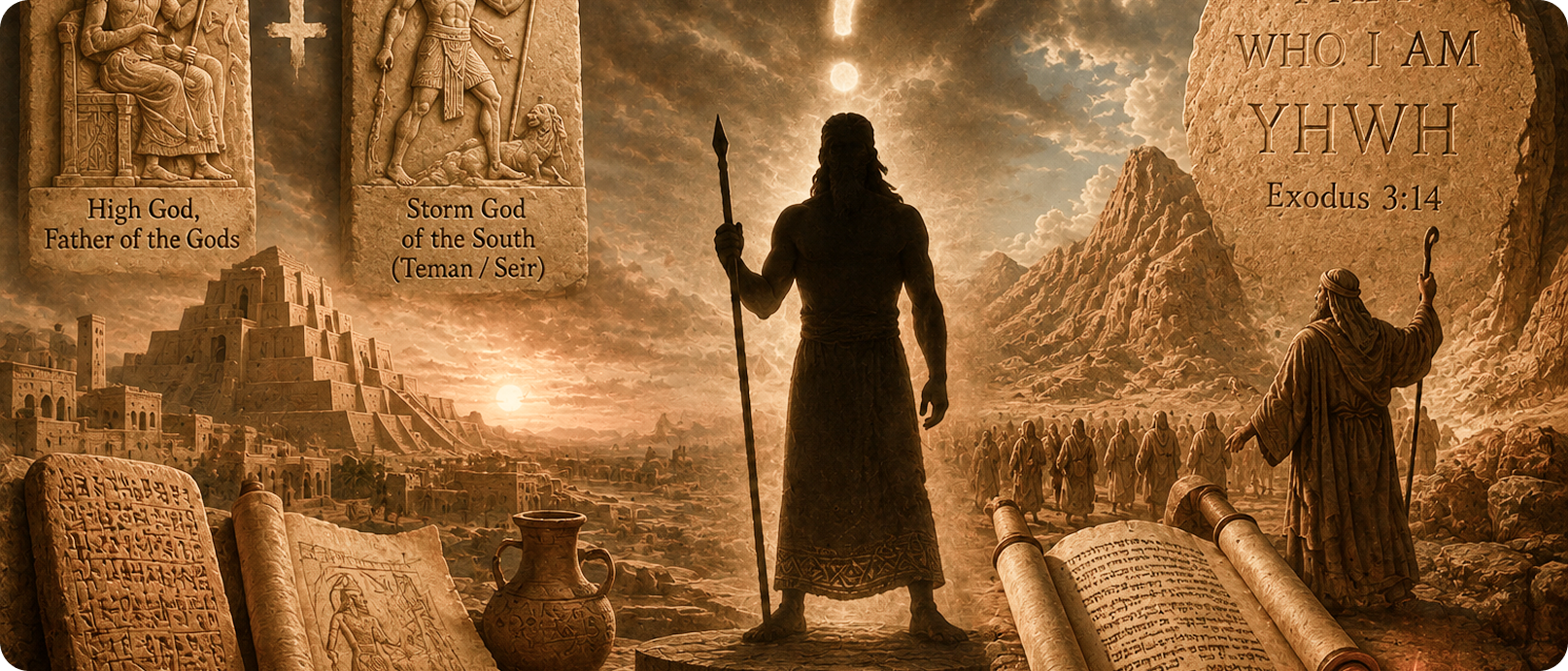
Later Hebrew manuscript traditions, the ones most modern Bibles are translated from, altered this passage to read “sons of Israel” instead of “sons of God”, a change that conveniently erases the implication that Yahweh was one son among several divine beings, each assigned a different nation by a higher god, typically identified with El. The older version of the text, however, preserves exactly that picture: a divine hierarchy, a chief god named El, and Yahweh as one deity within that structure rather than as the sole ruler of the cosmos.
Genesis and the Language of “Us”
Even the opening chapters of Genesis carry fingerprints of this older worldview, hiding in plain sight in a detail most readers skim right past. In Genesis 1:26, God says, “Let us make mankind in our image, in our likeness”, plural language that later theology would explain away as either a “royal we” or an early hint of the Trinity, depending on the tradition doing the explaining.
Read in its original ancient Near Eastern context, though, this plural language fits far more naturally into the same divine council framework found in Psalm 82 and the older layer of Deuteronomy 32. It reflects a god speaking to, and among, other divine beings, not a solitary deity talking to himself, but a chief god addressing the council he presides over, consistent with how other ancient Near Eastern creation accounts describe their own pantheons deliberating together.
From Many Gods to One
If ancient Israel’s earliest religious texts assume a populated divine realm, how did the tradition arrive at the strict monotheism most people associate with the Bible today? The shift happened gradually, tracked closely by biblical scholars through changes in language, emphasis, and editorial activity across different periods of Israelite history.
Early texts tend to reflect what scholars call monolatry, or henotheism, the belief that other gods exist, but that Israel is obligated to worship only its own national god, Yahweh. The famous command “you shall have no other gods before me” only makes sense within this framework: it’s not a claim that other gods don’t exist, but a demand for exclusive loyalty to one god among many that do.
True monotheism, the outright denial that any other gods exist at all, emerges more clearly in later texts, particularly those associated with the sweeping religious reforms under King Josiah in the seventh century BCE, and the editorial and theological work carried out during and after the Babylonian exile in the sixth century BCE. Facing conquest, displacement, and the real threat of cultural erasure, Israel’s religious leaders and scribes had a powerful incentive to elevate Yahweh not just above rival gods, but beyond the category of “gods” altogether, recasting him as the sole, uncreated ruler of a reality in which no other divine beings genuinely exist.
Why the Evidence Matters
None of this is a modern attack on faith dressed up as scholarship. It’s the mainstream conclusion of decades of biblical history and archaeology, built on close textual analysis, comparison with surrounding ancient Near Eastern religions, and the archaeological record from sites across the region. The picture that emerges is one of real historical development, a religious tradition that evolved, under real historical pressure, from one god among many toward the strict monotheism later inherited by Judaism, Christianity, and Islam alike.
For anyone questioning Christianity, working through their own faith deconstruction, or simply curious about the actual history behind biblical stories, this evidence offers something valuable: permission to ask hard questions of a text that, read honestly, is far stranger and more historically layered than most of us were ever taught. Ancient Israel wasn’t always monotheistic, and understanding how it got there tells us far more about real people navigating real history than any simplified version of the story ever could.
This post is adapted from research featured in Before One God: The Ancient Gods Behind the Biblical Tradition. For the full argument, complete with textual and archaeological sources, get your copy today.