Introduction
Ask most people where the God of the Bible came from, and you’ll get some version of the same answer: he’s always existed, exactly as he’s described, since before time began. It’s the answer built into the story itself, which is exactly why it deserves a second look.
The truth, laid out across decades of biblical history and archaeology, is more complicated and far more interesting than the Sunday school version. Long before Yahweh appears as the singular God of Israel, a god by a similar name and function shows up scattered across the wider ancient Near East, not as the only deity in existence, but as one god among many, with a father, a family, and a defined place within a much larger pantheon. The idea of Yahweh as the sole, eternal, uncreated God wasn’t the starting point of Israelite religion. It was the destination, reached slowly, over centuries, through politics, war, and the gradual consolidation of religious identity around a single national deity.
The Name Before the Nation
To understand where Yahweh came from, it helps to separate the name from the theology built around it later. Scholars researching the origins of Yahweh have traced possible references to a deity by a similar name to inscriptions and place names from the region of Edom and Midian, areas south and east of Israel, dating to well before Israel existed as a settled nation. Some of the earliest possible attestations appear in Egyptian texts referring to “the land of the Shasu of YHW”, a nomadic people associated with a specific desert region, not yet a religious movement, and certainly not yet monotheistic.
This detail matters because it complicates the traditional narrative in which Yahweh is revealed directly to Israel at Sinai as an entirely new, previously unknown God. The textual and geographical evidence instead suggests a god already known in the region, associated with mountains, storms, and warfare, the kind of deity common across the ancient Near East, who was later adopted, reinterpreted, and eventually elevated by a specific group of people who would become Israel.
A God With a Family
Perhaps the most striking evidence for Yahweh’s earlier, more crowded origins comes not from outside the Bible, but from within it, read carefully, in its earliest layers.
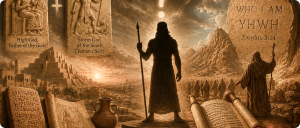
Deuteronomy 32:8-9, in some of the oldest surviving manuscript traditions, describes the “Most High” dividing the nations of the earth among “the sons of God,” with Yahweh receiving Israel as his particular portion. In this passage, Yahweh isn’t the Most High himself; he’s one of several divine sons, each assigned a nation, functioning within a divine hierarchy headed by another god entirely, commonly identified with El, the chief deity of the Canaanite pantheon.
This lines up with what archaeologists have independently reconstructed about Canaanite religion from sites like Ugarit, where extensive tablets describe El as the aging patriarch god, presiding over a divine council, married to the goddess Asherah, and father to a large family of lesser gods, a family that, in the earliest strata of Israelite tradition, appears to have included Yahweh as one son among many, rather than as the singular, uncreated deity he would later become.
From One God Among Many to the Only God
If Yahweh started as a regional deity, a son of El, a storm-and-war god associated with a specific desert people, how did he become the sole God of an entire tradition, and eventually of billions of people across multiple world religions?
The honest answer, drawn from comparative religion and textual criticism rather than theology, is that the transformation happened gradually, and it happened for reasons that had far more to do with politics and survival than with revelation. As Israel consolidated into a kingdom, and later split, fought wars, and faced conquest and exile at the hands of larger empires, religious identity became tied to national identity in increasingly urgent ways. A people under threat of cultural and political erasure had a strong incentive to elevate their national god above all rivals, not merely as the best god, but eventually as the only real one.
This shift shows up in the biblical text itself as a shift in language and emphasis. Earlier texts tend to assume the existence of other gods while insisting Israel should worship only Yahweh, a position scholars call monolatry, or henotheism. Later texts, particularly those associated with the reforms under King Josiah and the editorial work done during and after the Babylonian exile, move toward true monotheism: not just “worship Yahweh alone,” but “no other gods exist at all.” The theological claim got stronger precisely as the political stakes got higher.
Why This Matters
None of this is a fringe theory whispered about on the internet. It’s the mainstream, well-documented conclusion of decades of work in comparative religion, ancient Near Eastern archaeology, and biblical textual criticism, the kind of research that lives in academic journals and university presses, rarely making its way to the person sitting in a pew on Sunday morning, or lying awake at 3 a.m. wondering why the story never quite added up.
Understanding where the God of the Bible actually came from doesn’t require abandoning faith, and it doesn’t require accepting anyone else’s conclusions wholesale. But it does require being willing to look at the evidence honestly- the inscriptions, the manuscripts, the archaeological record, rather than accepting the simplified version handed down through centuries of institutional retelling.
The story of Yahweh’s origins is, in many ways, more compelling than the simplified version most of us were taught. It’s a story about a small, vulnerable people building and rebuilding their understanding of the divine in response to real historical pressures, war, exile, survival, and how a regional god, once one voice among many in a crowded divine council, became, over centuries, the God worshipped by roughly half the planet today.
That’s not a story that diminishes the God of the Bible. If anything, it’s a far more human, far more historically grounded story than the one most of us inherited, and it’s exactly the kind of question worth asking, whether you’re deep into your own faith deconstruction or simply curious about where any of this actually came from.